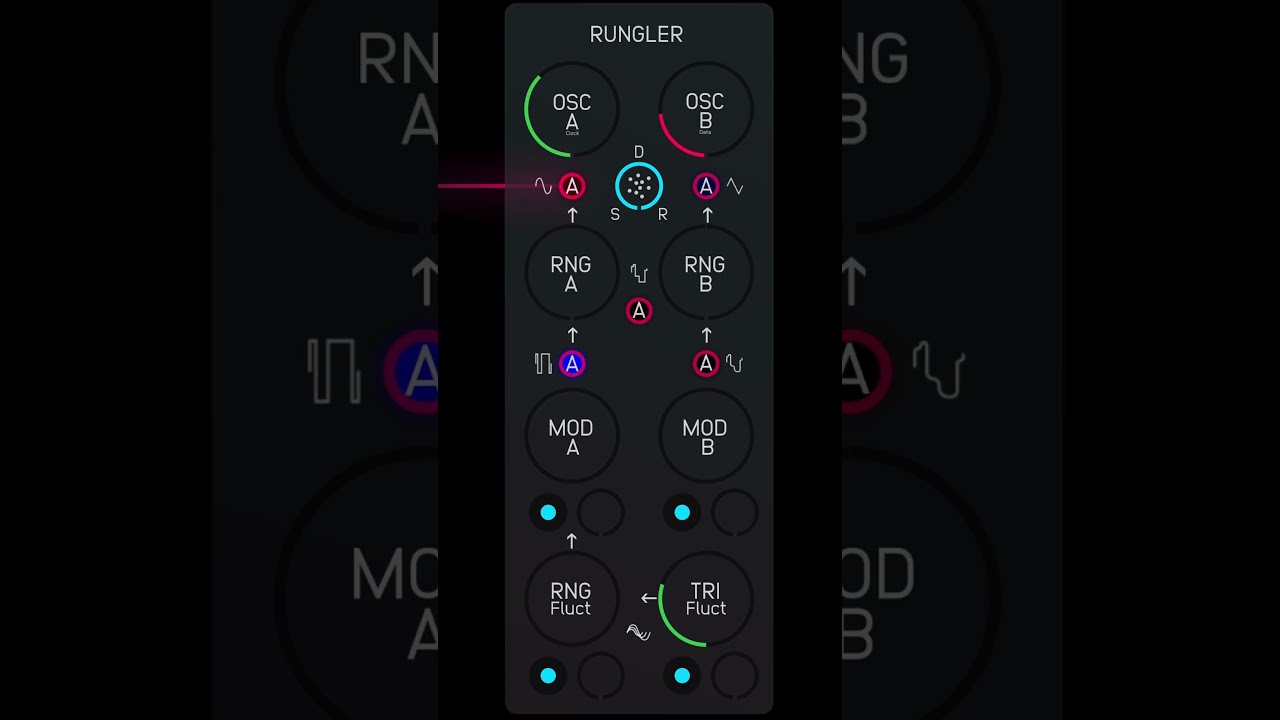
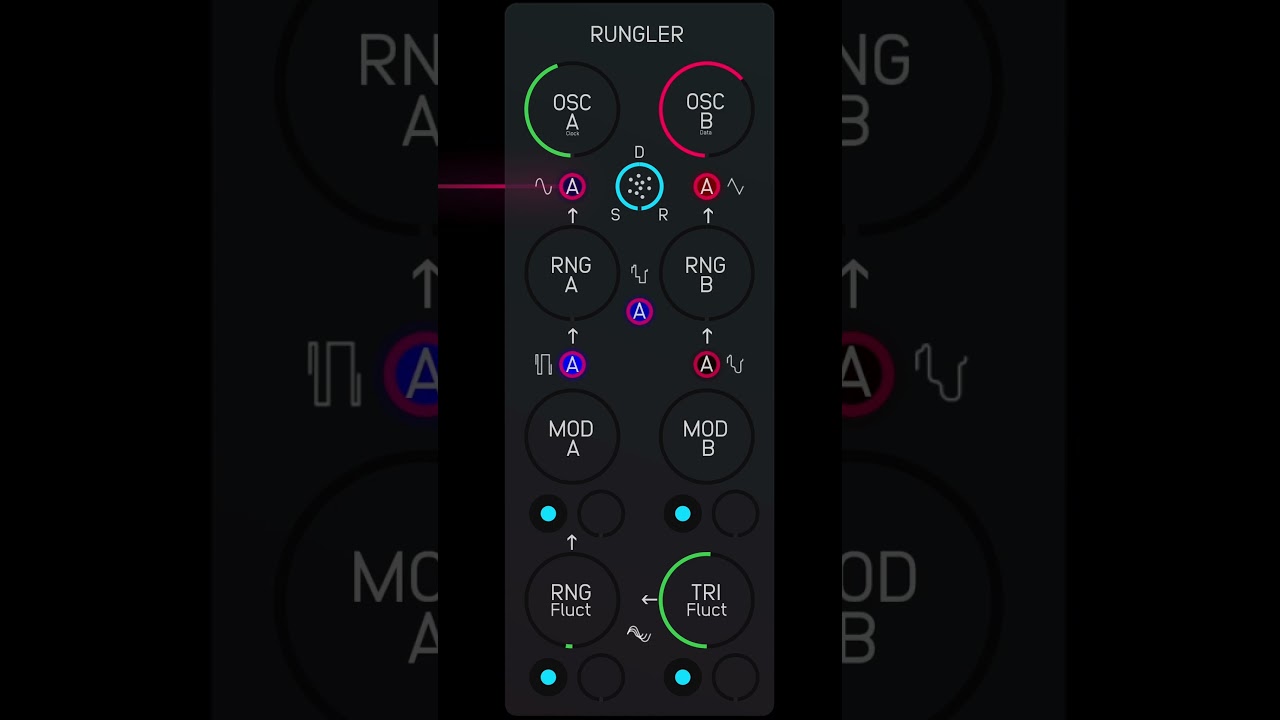
Hordijk’s Rungler has been on my to-do list for a long time. It’s the only Hordijk module that I’d never gotten round to making my own version of – until now. @STSchoen had made a version in Audulus 3, and I’d made my own version of that, as well as expanding on his Benjolin patch in my Audulin version of that circuit, and after having had some fun with the shift registers in my recent drum sequencer, the moment seemed ripe for taking a fresh look at the Rungler – this time building it from the ground up.
Hordijk’s Rungler grew out of the desire to create a noise generator that went a little further than the basic noise sources typically available in synthesizers. Inspired by the works of Jan Boerman, he embarked on putting together a circuit that could create a continuum from the simplicity of a sine wave to the complexity of white noise, and embrace the many ‘chaotic’ steps bordering on stability between those two extremes.
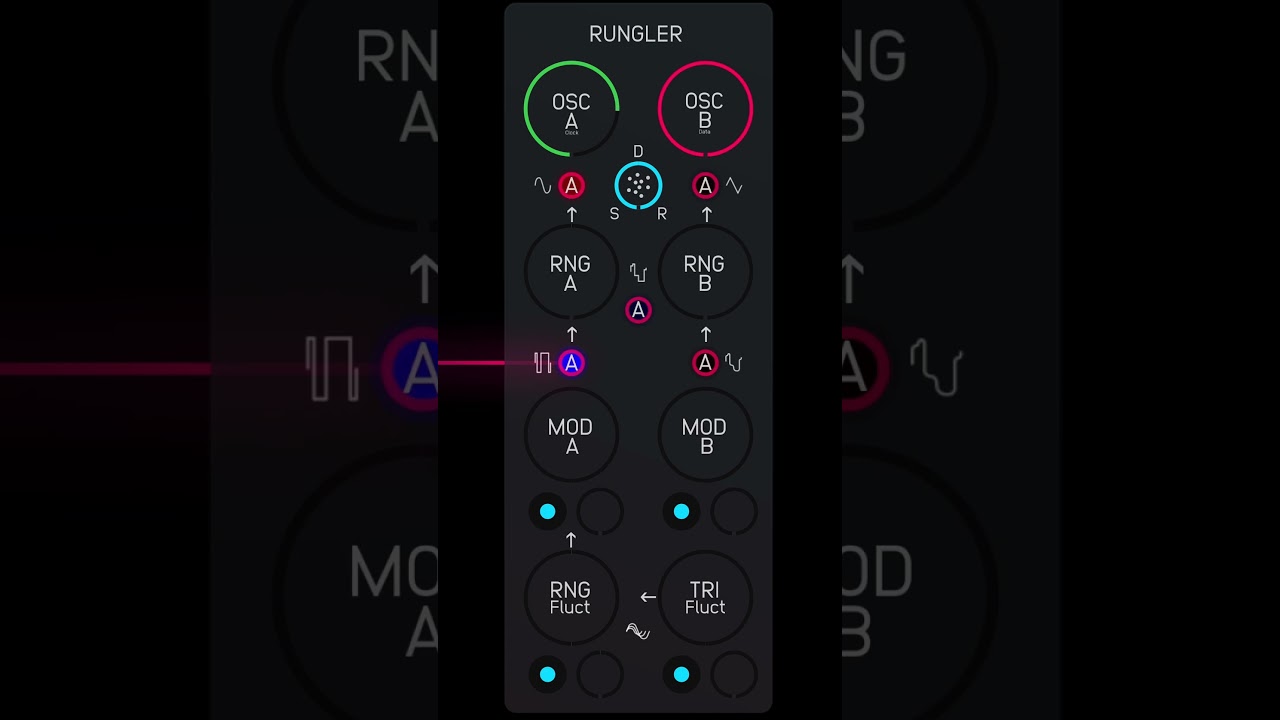
Hordijk’s flagship module version of his Rungler circuit is built around a 32-bit shift register driven by two wide-range oscillators. Oscillator A clocks the register and Oscillator B is connected to its data input. The resulting interference patterns can range from simple repetitions to chaotic textures. (See the origin story in this video, and a demonstration of the module by Hordijk himself: @NOVARS )
However, when Oscillator B is tuned lower than Oscillator A, the shift register defaults to an algorithm that creates pseudo-random patterns unaffected by data input from Oscillator B. I.e. by shifting B to a frequency lower than A, one can dip into a pool of randomness, and then lock what one finds there into a repeating pattern by shifting B back up again. See the module description for further details.
New Rungler v.1.1.1 Demo 1 RM.audulus4 (181.2 KB)
New Rungler v.1.1.1 Demo 2 RM.audulus4 (181.2 KB)
Hordijk Rungler: Random Mode
Oscillator A clocks a shift-register noise generator.
When Oscillator B is higher than A the contents of the register is looped. I.e. by shifting B to a frequency lower than A, one can dip into a pool of randomness, and then lock what one finds there into a repeating pattern by shifting B back up again.
Hordijk Rungler: Dense/Sparse Modes
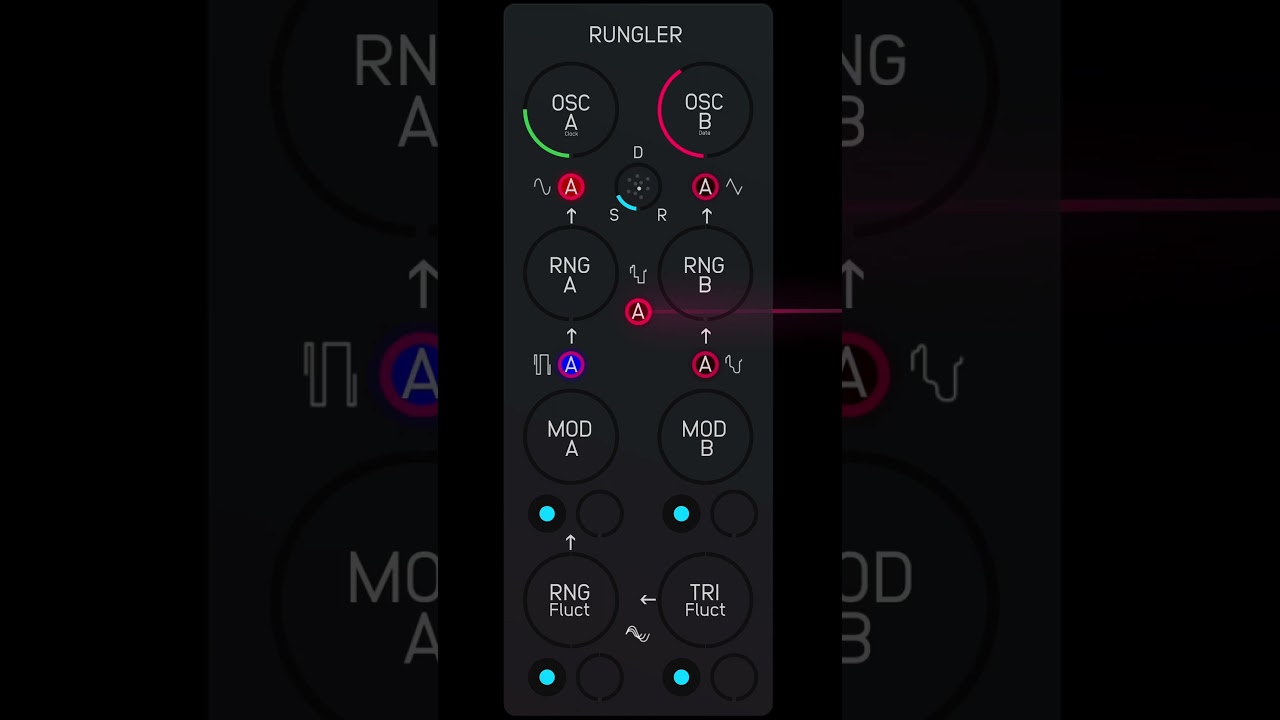
The stepped output of the shift register drives an external oscillator. To start with the pseudo-random pattern sounds like noise but as Oscillator B approaches the frequency of Oscillator A interference patterns create short melodic sequences. These sequences can be simplified by shifting the density knob to ‘Sparse’, or changed by changing the frequency of Oscillator B. Shifting Oscillator B below the frequency of Oscillator A fills the register with randomness, shifting it up again creates new interference patterns over whatever randomness has been collected.
Hordijk Rungler: Dense/Sparse/Random Modes
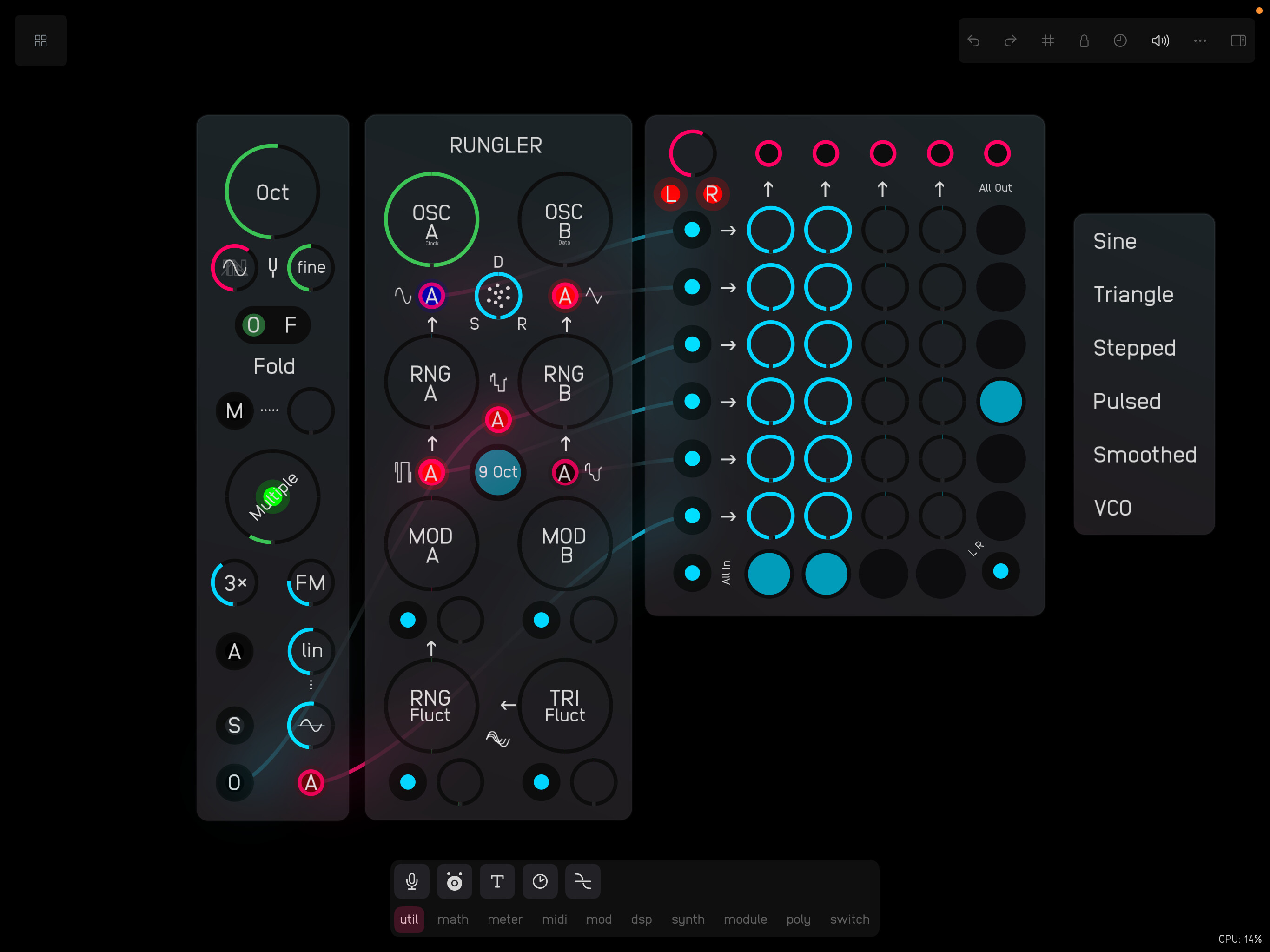
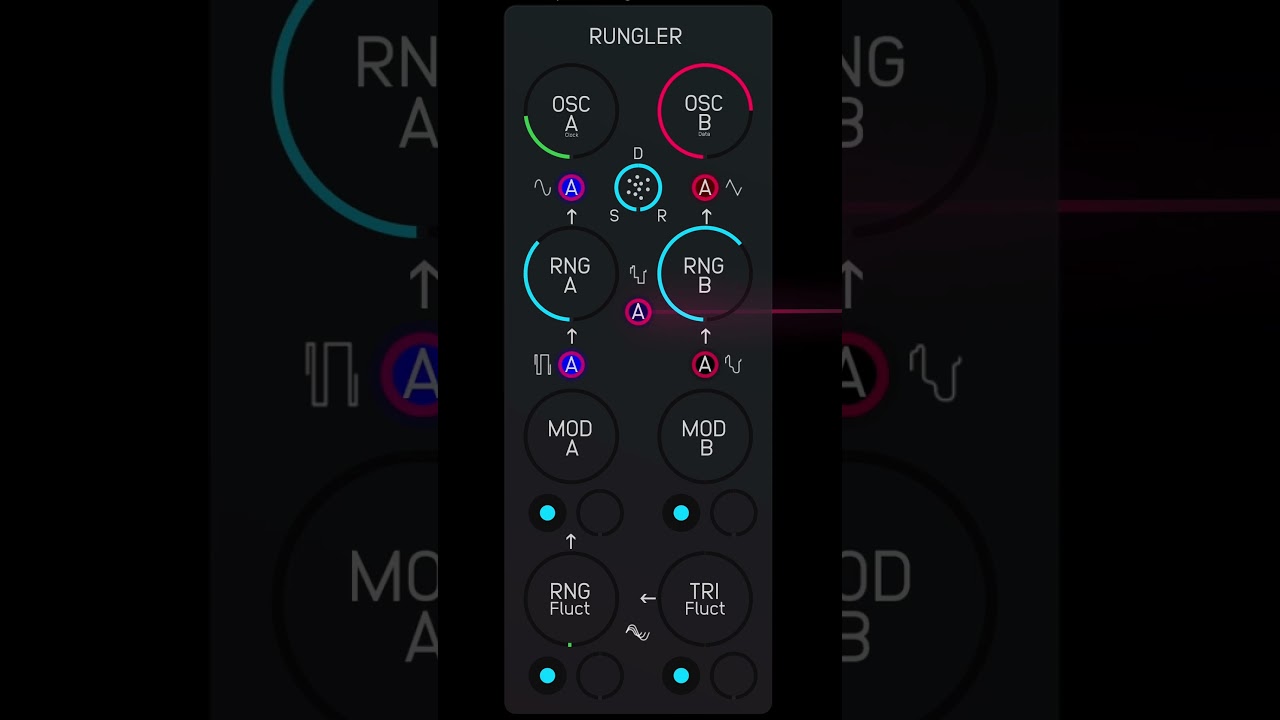
Playing around with interference patterns by shifting the clock frequency slightly above or below the data input from Oscillator B. In Random Mode the contents of the register is looped if Oscillator B is higher than A. Various outputs from the register; stepped, pulsed and smoothed can be fed back to modulate oscillators A and B. Fluctuation modulation affects both frequency and amplitude, with an increase in frequency corresponding to a decrease in amplitude.
(The stepped output of the shift register drives an external oscillator.)
Hordijk Rungler: Fluctuation Modulation
Fluctuation modulation affects both frequency and amplitude, with an increase in frequency corresponding to a decrease in amplitude.
Hordijk Rungler: Sub-Harmonic Soft-Sync
If Oscillator B is tuned higher than A, and Fluctuation modulation is increased to a sufficient level, Oscillator A will soft sync following the nodes of a sub-harmonic series.
Rungler Shift Register lights (open up the module to take a peek for yourself).